EL SÍNDROME DE NEURODERMATITIS, O LIQUEN SIMPLE CRÓNICO. !
THE NEURODERMATITIS SYNDROME, OR LICHEN SIMPLEX CHRONICUS. !
NEURODERMATITIS DEL TOBILLO


PUBLICADO 2.017 ACTUALIZADO 2.025

EDITORIAL ESPAÑOL
===================
Hola amigos de la red, DERMAGIC EXPRESS hoy con un tema bastante interesante: EL SÍNDROME DE NEURODERMATITIS, también conocido como LIQUEN SIMPLE CRÓNICO (LSC). Algunos autores incluyen esta patología dentro del capítulo de LA DERMATITIS ATÓPICA, como una variante de ella.
===================
Hola amigos de la red, DERMAGIC EXPRESS hoy con un tema bastante interesante: EL SÍNDROME DE NEURODERMATITIS, también conocido como LIQUEN SIMPLE CRÓNICO (LSC). Algunos autores incluyen esta patología dentro del capítulo de LA DERMATITIS ATÓPICA, como una variante de ella.
1.) HISTORIA:
EL LIQUEN SIMPLE CRÓNICO fue descrito por primera vez por el
dermatólogo español
Luis Expectación Azúa
a finales del siglo XIX,
quien comunicó varios casos de lesiones cutáneas caracterizadas
por áreas de piel engrosada, hiperpigmentada y con gran prurito,
las cuales denomino inicialmente como
“epitelioma cutáneo vegetante pseudoinflamatorio”.
El término "NEURODERMATITIS" comenzó a usarse para referirse al LIQUEN SIMPLE CRONICO a finales del siglo XIX y principios del siglo XX. Específicamente, en 1891.
El término "NEURODERMATITIS" comenzó a usarse para referirse al LIQUEN SIMPLE CRONICO a finales del siglo XIX y principios del siglo XX. Específicamente, en 1891.
Para esa época los dermatólogos franceses
Jean Louis Brocq
y
Lucien Jacquet describieron una dermatosis caracterizada por lesiones de piel con un
INTENSO PRURITO, la cual denominaron
"NEURODERMATITIS DISEMINADA Y DEL SISTEMA NERVIOSO",
haciendo énfasis en el componente nervioso del prurito, o "picazón".
A mediados del siglo XX, esta enfermedad fue reconocida como
una DERMATITIS CRÓNICA, cuya causa principal es el
"RASCADO" o roce
repetido y se le dio el nombre "OFICIAL" de
LIQUEN SIMPLE CRONICO (LSC), o NEURODERMATITIS, para enfatizar la CONEXIÓN entre el PRURITO o picazón con
componentes NERVIOSOS.
2.) CARACTERÍSTICAS CLÍNICAS:
LA NEURODERMATITIS o LIQUEN SIMPLE CRÓNICO, tienen un conjunto de signos y síntomas que permiten denominarlo como EL SÍNDROME DE NEURODERMATITIS, y ellos son:
A.) PRURITO INTENSO: EN AREAS AFECTADAS, PREFERIBLEMENTE DE NOCHE.
B.) AFECTA POR IGUAL ADULTOS MASCULINOS Y FEMENINOS: ENTRE 35 Y 50 AÑOS O MAS.
C.) HAY UN COMPONENTE PSICOLÓGICO EN LOS AFECTADOS: ESTRÉS, INCONFORMIDAD CON ALGÚN AREA DEL CUERPO.
D.) ANTECEDENTES DE ALERGIA EN LOS AFECTADOS:
DERMATITIS POR CONTACTO,
ATOPIA, RINITIS, SINUSITIS, ASMA.
3.) AREAS MAS COMÚNMENTE AFECTADAS:
A.) MIEMBROS INFERIORES: PIERNAS, DORSO DEL PIE,
B.) VULVA.
C.) ESCROTO.
D.) REGION PERI-ANAL.
E.) CUELLO.
F.) ZONAS FLEXURALES.
G.) ESPALDA,
Pero puede presentarse en otras areas del cuerpo, como: brazos,
dorso de manos, antebrazos, e incluso cara.
NEURODERMATITIS PIERNA

A.- La enfermedad puede comenzar con un EVENTO PRIMARIO como: simple roce de la tela de la ropa con la piel, contacto con algún irritante, perfumes en la piel, cremas cosméticas de mala calidad, afeitado de las piernas, picaduras de insectos.
B.- Este primer evento provoca COMEZÓN O PRURITO y la persona comienza a rascarse el área afectada, SIENDO ESTE EL SEGUNDO EVENTO y quizá el mas importante en esta enfermedad.
C.- El prurito se vuelve "INSOPORTABLE"
y los pacientes recurren a REMEDIOS CASEROS Y CREMAS INADECUADAS, que empeoran la piel, la cual adquiere un aspecto
engrosado, y no dejan de rascarse, lo cual empeora la
condición.
D.- El tercer evento lo constituye la formación de LA LESION, la cual comienza por ser una placa eritematoescamosa circunscrita, la cual a medida que el paciente se rasca se va agrandando, y posteriormente en muchos casos la lesión se infecta convirtiéndose en una ENFERMEDAD CRÓNICA, pues el paciente no deja de rascarse.
D.- El tercer evento lo constituye la formación de LA LESION, la cual comienza por ser una placa eritematoescamosa circunscrita, la cual a medida que el paciente se rasca se va agrandando, y posteriormente en muchos casos la lesión se infecta convirtiéndose en una ENFERMEDAD CRÓNICA, pues el paciente no deja de rascarse.
De allí el nombre de
LIQUEN SIMPLE CRÓNICO (LSC),
que significa LESION SIMPLE CRÓNICA DE LA PIEL.
(producida por el rascado)
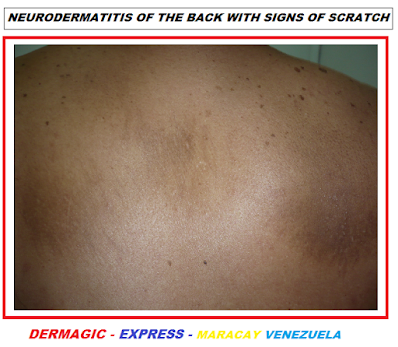
NEURODERMATITIS DE LA ESPALDA CON SIGNOS DE RASCADO

E.- La palabra LIQUEN, viene del término LIQUENIFICACION, que significa ENGROSAMIENTO DE LA PIEL, y ello se produce por el rascado continuo de la misma.
G.- La mayoría de los pacientes va a la consulta diciendo que padece de "HONGO" y empeora sus lesiones por colocarse cremas inadecuadas, además de "inventos caseros" como hierbas, alcohol, jabón azul, creolina, etc.
H.- El común denominador de estos pacientes es el ESTRÉS y deseo incontrolable por rascarse la piel, por ello algunos autores incluyen esta patología dentro de las PSICODERMATOSIS, ya que la consideran de origen PSICOSOMÁTICO.
El mejor término que se le puede dar al LIQUEN SIMPLE CRÓNICO es el de SÍNDROME DE NEURODERMATITIS; para un paciente es "mas fácil" entender este termino, que el de LIQUEN SIMPLE CRÓNICO, porque es un conjunto de síntomas donde hay una afectación NEUROLÓGICA, que como dijimos, la mayoría de las veces es ANSIEDAD o ESTRÉS.
4.) TRATAMIENTO GENERAL:
El tratamiento del LIQUEN SIMPLE CRÓNICO o NEURODERMATITIS debe
estar dirigido a "CORTAR" EL CICLO DEL RASCADO, una vez hecho esto más un buen
tratamiento TÓPICO, las lesiones desaparecen la mayoría de las
veces sin dejar secuela.
LIQUEN AMILOIDE DE LA ESPALDA PRODUCTO DE CONTINUO RASCADO POR
NEURODERMATITIS PREVIA

En algunos casos el daño ocasionado a la piel deja secuelas
principalmente marcas
HIPERPIGMENTADAS. En casos muy crónicos, la piel toma un aspecto amarillento por la deposición de una
sustancia llamada
AMILOIDE, siendo entonces denominado LIQUEN AMILODE, el cual también es consecuencia del rascado, y NO está
relacionado con la enfermedad
AMILOIDOSIS CUTIS la
cual es sistémica. Es importante que sepas esto.
5.) TRATAMIENTOS ESPECÍFICOS:
1.) ANTIHISTAMÍNICOS.
2.) ESTEROIDES TÓPICOS.
3.) UREA.
4 ) ÁCIDO SALICÍLICO.
5.) HIDRATANTES.
6.) ANTIDEPRESIVOS, EN CASOS SEVEROS.
5.) TRATAMIENTOS ESPECÍFICOS:
1.) ANTIHISTAMÍNICOS.
2.) ESTEROIDES TÓPICOS.
3.) UREA.
4 ) ÁCIDO SALICÍLICO.
5.) HIDRATANTES.
6.) ANTIDEPRESIVOS, EN CASOS SEVEROS.
7.)
FORMULAS MAGISTRALES.
8.)
PIMECROLIMUS Y TACROLIMUS. ( Estas dos medicinas hoy día llevan en su empaque una CAJA NEGRA O BLACK BOK, advertencia de SEGURIDAD mas grave en los EE.UU, porque a largo
plazo pueden producir cáncer, "supuestamente" NO PROBADO, pero hoy dia se mantienen estas
advertencias.
6.) NUEVOS TRATAMIENTOS:
Pocos tratamientos NUEVOS han sido descritos para el tratamiento del
LIQUEN SIMPLE CRÓNICO o NUERODERMATITIS, entre ellos:
B.-
Crioterapia.
(Nitrógeno Liquido).
C.- Nuevos antidepresivos en casos severos:
duloxetina
D. Inhibidores de la JANUS KINASA (JAK): Baricitinib, Upadacitinib,
Abrocitinib, Ruxolitinib.
7.) CONCLUSIONES:
Es importante que sepas que en muchos casos LA NEURODERMATITIS se inicia como una ALERGIA POR CONTACTO a una sustancia especifica, calzado, cuero o tela, y al instalarse el CICLO RASCADO - ENGROSAMIENTO DE LA PIEL - RASCADO, queda tipificada la enfermedad, separándose de LA DERMATITIS POR CONTACTO o ATOPIA, quienes por lo general fueron los desencadenantes.
Dato final para todos los pacientes quienes padecen de LIQUEN SIMPLE CRONICO (LSC) o NEURODERMATITIS:
“…… MIENTRAS MAS TE RASQUES LA PIEL , mas ENGROSAMIENTO Y DAÑO DE LA MISMA y MAS COMEZÓN, lo que provocara MAS RASCADO… un circulo vicioso del cual solo se saldrá DEJANDO DE RASCAR LA PIEL…..” De modo que:
Necesitas un buen tratamiento en dos AREAS: PARA EL PRURITO o COMEZÓN, y TÓPICO para la piel.
En las referencias los hechos, en las fotos varios tipos DE LIQUEN SIMPLE CRÓNICO (LSC).
Saludos a todos.
Dr. José Lapenta
Dr. José M. Lapenta
EDITORIAL ENGLISH===================
Hello friends of the network, DERMAGIC EXPRESS today with a very
interesting topic: THE NEURODERMATITIS SYNDROME, also known
as LICHEN SIMPLEX CHRONICUS (LSC). Some authors include this
pathology within the chapter on ATOPIC DERMATITIS, as a variant of
it.
1.) HISTORY:
LICHEN SIMPLEX CHRONICUS (LSC) was first described by the Spanish dermatologist Luis Expectación Azúa in the late 19th century, who reported several cases of skin lesions characterized by areas of thickened, hyperpigmented skin with intense itching, which he initially called "pseudoinflammatory vegetating cutaneous epithelioma."
The term "NEURODERMATITIS" began to be used to refer to LICHEN SIMPLEX CHRONIC in the late 19th and early 20th centuries, specifically in 1891.
Around that time, the French dermatologists Jean Louis Brocq and Lucien Jacquet described a dermatosis characterized by skin lesions with INTENSE ITCHING, which they called "disseminated neurodermatitis of the nervous system," emphasizing the nervous component of the PRURITUS, or "ITCHING"
In the mid-20th century, this disease was recognized as a chronic dermatitis, whose main cause is repeated scratching or rubbing, and was given the official name of LICHEN SIMPLEX CHRONICUS (LSC), or NEURODERMATITIS, to emphasize the connection between pruritus or itching and nervous system components.
2.) CLINICAL CHARACTERISTICS:
Neurodermatitis, or lichen simplex chronicus, has a set of signs and symptoms that allow it to be called neurodermatitis syndrome, and these are:
A.) INTENSE PRURITUS IN AFFECTED AREAS: preferably at night.
B.) IT AFFECTS ADULTS EQUALLY: men and women between 35 and 50 years of age or older.
C.) THERE IS A PSYCHOLOGICAL COMPONENT IN THOSE AFFECTED: stress, dissatisfaction with some area of the body.
D.) HISTORY OF ALLERGIES IN THOSE AFFECTED: contact dermatitis, atopy, rhinitis, sinusitis, asthma.
E.) THERE IS A PSYCHOLOGICAL COMPONENT IN THE AFFECTED: STRESS, DISCOMFORT WITH ANY AREA OF THE BODY.
2.) AREAS MORE COMMONLY AFFECTED:
A.) LOWER LIMBS: LEGS AND FEET.
B.) VULVA.
C.) SCROTUM.
D. PERI-ANAL REGION.
E.) NECK.
 F.) FLEXURIAL ZONES.
F.) BACKGROUND OF ALLERGY IN THE AFFECTED:
CONTACT DERMATITIS, ATOPIA, RHINITIS, SINUSITIS, ASTHMA.
A.) LOWER LIMBS: LEGS AND FEET.
B.) VULVA.
C.) SCROTUM.
D. PERI-ANAL REGION.
E.) NECK.
G.) BACK.
But it can appear in other areas of the body, such as: arms, back of hands, forearms, and even face.
3.) EVOLUTION:
A.- The disease can begin
with a PRIMARY EVENT such as:
simple rubbing of the clothing with the skin, contact with some
irritant, perfume or fragrance on the skin, poor cosmetic creams,
shaving of the legs.
B.- This first event causes ITCHING OR PRURITUS and the person begins to scratch the affected area, BEING THIS THE SECOND EVENT and perhaps the most important in this disease.
B.- This first event causes ITCHING OR PRURITUS and the person begins to scratch the affected area, BEING THIS THE SECOND EVENT and perhaps the most important in this disease.
C.- Pruritus becomes "UNBEREABLE"
and patients appeal to HOME REMEDIES and
IMPROPERED CREAMS, which worsen the skin, which becomes
thickened.
D.- THE THIRD EVENT is the formation of THE LESION which begins as a circumscribed erythematous-squamous plaque, which, as the patient scratches, enlarges, and in many cases, the lesion becomes infected, becoming a CHRONIC DISEASE.
D.- THE THIRD EVENT is the formation of THE LESION which begins as a circumscribed erythematous-squamous plaque, which, as the patient scratches, enlarges, and in many cases, the lesion becomes infected, becoming a CHRONIC DISEASE.
The patient does not stop scratching. Hence the name
LICHEN SIMPLEX CHRONICUS, which means
SIMPLE AND CHRONIC LESION OF THE SKIN.
 E.- The word LICHEN
comes from the term
LICHENIFIED, which means
THICKENING OF THE SKIN, and this is produced by the continuous scratching of it.
E.- The word LICHEN
comes from the term
LICHENIFIED, which means
THICKENING OF THE SKIN, and this is produced by the continuous scratching of it.
F.- The most affected areas in medical practice are in women: the VULVAR region, LOWER LIMBS AND PERIANAL REGION. In the man: SCROTUM, LOWER LIMBS AND PERIANAL REGION.
G.- Most patients go to the office saying that they have "FUNGUS" and worsen their injuries by placing inappropriate creams, besides "homemade inventions" such as herbs, alcohol, blue soap, creoline etc.
H.- The common denominator of these patients is the STRESS and uncontrollable desire to scratch the skin, so some authors include this pathology within PSYCHODERMATOSES, since they consider it of PSYCHOSOMATIC origin.
The best term that can be given to LICHEN SIMPLEX CHRONICUS is the NEURODERMATITIS SYNDROME; For a patient, this term is "easier" to understand than that of CHRONIC LICHEN SIMPLEX, because it is a set of symptoms where there is a NEUROLOGICAL involvement, which, as we said, is most often ANXIETY or STRESS.
F.- The most affected areas in medical practice are in women: the VULVAR region, LOWER LIMBS AND PERIANAL REGION. In the man: SCROTUM, LOWER LIMBS AND PERIANAL REGION.
G.- Most patients go to the office saying that they have "FUNGUS" and worsen their injuries by placing inappropriate creams, besides "homemade inventions" such as herbs, alcohol, blue soap, creoline etc.
H.- The common denominator of these patients is the STRESS and uncontrollable desire to scratch the skin, so some authors include this pathology within PSYCHODERMATOSES, since they consider it of PSYCHOSOMATIC origin.
The best term that can be given to LICHEN SIMPLEX CHRONICUS is the NEURODERMATITIS SYNDROME; For a patient, this term is "easier" to understand than that of CHRONIC LICHEN SIMPLEX, because it is a set of symptoms where there is a NEUROLOGICAL involvement, which, as we said, is most often ANXIETY or STRESS.
4.) GENERAL TREATMENT:
The treatment of LICHEN SIMPLEX CHRONICUS or NEURODERMATITIS should be directed to "CUT" THE CYCLE OF THE SCRATCH, once this is done plus a good TOPICAL treatment, the lesions disappear most of the time without leaving a sequel.
In some cases the damage caused to the skin leaves sequels mainly HYPERPIGMENTED marks. In very chronic cases. The skin takes on a yellowish appearance by the
deposition of a substance called AMYLOID, which is then called
LICHEN AMYLOIDOSUS, which is also a consequence of scratching,
and is not related to the AMYLOIDOSUS CUTIS disease, which is systemic.
It is important that you know this.
5.) SPECIFIC TREATMENTS:
5.) SPECIFIC TREATMENTS:
1.) ANTIHISTAMINICS.
2.) TOPICAL STEROIDS.
3.) UREA.
4) SALICYLIC ACID.
5.) MOISTURIZERS.
6.) ANTIDEPRESSIVE, IN SEVERE CASES.
2.) TOPICAL STEROIDS.
3.) UREA.
4) SALICYLIC ACID.
5.) MOISTURIZERS.
6.) ANTIDEPRESSIVE, IN SEVERE CASES.
7.) MAGISTRAL FORMULATIONS.
8.) PIMECROLIMUS AND TACROLIMUS. (These two medicines today have a BLACK BOX or on their
packaging, a more serious SAFETY warning in the US, because in the long
term they can cause cancer, "Supposedly" NOT PROVEN, but these warnings
remain today.
6.) NEW TREATMENTS:
Few NEW treatments have been described for the treatment of CHRONIC
LICHEN SIMPLEX or NEURODERMATITIS, among them:
A. Fractional Carbon Dioxide Laser (CO2).Not highly recommended.
B. Cryotherapy. (Liquid Nitrogen).
C. New antidepressants in severe cases: duloxetine.
D. Janus kinase (JAK) inhibitors: baricitinib, upadacitinib, abrocitinib, ruxolitinib.
A. Fractional Carbon Dioxide Laser (CO2).Not highly recommended.
B. Cryotherapy. (Liquid Nitrogen).
C. New antidepressants in severe cases: duloxetine.
D. Janus kinase (JAK) inhibitors: baricitinib, upadacitinib, abrocitinib, ruxolitinib.
7.) CONCLUSIONS:
It is important that you know that in many cases NEURODERMATITIS starts as an ALLERGY BY CONTACTING a specific substance, footwear, leather, or clothes, and when the CYCLE SCRATCHING - THICKENED SKIN - MORE SCRATCHING, it is produced, the disease is defined, separating from CONTAC DERMATITIS or ATOPIA, who were usually the triggers.
Final data for all patients suffering from LICHEN SIMPLEX CHRONICUS or NEURODERMATITIS:
"...... WHILE YOU SCRATCH THE SKIN, MORE THICKENED BECOME, CAUSING MORE ITCHING , which will cause MORE SCRATCHING... a vicious circle from which will only come out LEAVING TO SCRATCH THE SKIN ...." So that:"
You need a good treatment in two WAYS: FOR THE PRURITUS OR ITCHING, and TOPICAL for the skin.
In the references the facts, in the photos several types LICHEN SIMPLEX CHRONICUS (LSC).
Greetings to all.
Dr. José Lapenta
It is important that you know that in many cases NEURODERMATITIS starts as an ALLERGY BY CONTACTING a specific substance, footwear, leather, or clothes, and when the CYCLE SCRATCHING - THICKENED SKIN - MORE SCRATCHING, it is produced, the disease is defined, separating from CONTAC DERMATITIS or ATOPIA, who were usually the triggers.
Final data for all patients suffering from LICHEN SIMPLEX CHRONICUS or NEURODERMATITIS:
"...... WHILE YOU SCRATCH THE SKIN, MORE THICKENED BECOME, CAUSING MORE ITCHING , which will cause MORE SCRATCHING... a vicious circle from which will only come out LEAVING TO SCRATCH THE SKIN ...." So that:"
You need a good treatment in two WAYS: FOR THE PRURITUS OR ITCHING, and TOPICAL for the skin.
In the references the facts, in the photos several types LICHEN SIMPLEX CHRONICUS (LSC).
Greetings to all.
Dr. José Lapenta
Dr. José M. Lapenta
==========================================================================
REFERENCIAS BIBLIOGRÁFICAS / BIBLIOGRAPHICAL REFERENCES
=========================================================================
REFERENCIAS BIBLIOGRÁFICAS / BIBLIOGRAPHICAL REFERENCES
=========================================================================
A.- Lichen Simplex Chronicus: Clinical Perspectives and Emerging
Therapeutic Strategies (2025).
B.- Evaluating Duloxetine for Pruritus and Psychiatric Comorbidities in Lichen Simplex Chronicus (2025).
C.- Efficacy and Safety of Liquid Nitrogen Cryotherapy for Lichen Simplex Chronicus: A Meta-Analysis (2022).
D.- Fractional Carbon Dioxide Laser for Lichen Simplex Chronicus: A Randomized Controlled Trial (2025).
E.- Lichen Simplex Chronicus Itch: An Update (2022).
B.- Evaluating Duloxetine for Pruritus and Psychiatric Comorbidities in Lichen Simplex Chronicus (2025).
C.- Efficacy and Safety of Liquid Nitrogen Cryotherapy for Lichen Simplex Chronicus: A Meta-Analysis (2022).
D.- Fractional Carbon Dioxide Laser for Lichen Simplex Chronicus: A Randomized Controlled Trial (2025).
E.- Lichen Simplex Chronicus Itch: An Update (2022).
=========================================================================
1.) [Neurodermatitis : Atopy of the skin].
2.) Differences Between Men and Women in Chronic Scratching: A
Psychodermatologic Study in Lichen Simplex Chronicus.
3.) Personality differences between patients with lichen simplex chronicus and normal population: A study of pruritus.
4.) Sleep disturbance in patients with lichen simplex chronicus and its relationship to nocturnal scratching: A case control study.
5.) Lichen simplex chronicus (atopic/neurodermatitis) of the anogenital region.
6.) Increased risk of lichen simplex chronicus in people with anxiety disorder: a nationwide population-based retrospective cohort study.
7.) Emotions and skin (II)-the conditioning of scratch responses in cases of lichen simplex.
8.) Lichen simplex chronicus - A Psychocutaneous disorder?
9.) Lichen simplex chronicus as a symptom of neuropathy.
10.) Clinical, epidemiological and therapeutic profile of patients with brachioradial pruritus in a reference service in dermatology.
11.) Study of pruritus vulvae in geriatric age group in tertiary hospital.
12.) Lichenoid vulvar disease: A review.
13.) Lichen simplex chronicus of the eyelid.
14.) Lichen amyloidosus: a consequence of scratching.
15.) Managing vulvar lichen simplex chronicus.
16.) Prurigo nodularis and lichen simplex chronicus.
17.) [Lichen amyloidosus--disease entity or the effect of scratching].
18.) Clinical Study of 124 Patients Having Perianal Dermatitis.
19.) Lichen simplex chronicus (atopic/neurodermatitis) of the anogenital region.
20.) Antidepressants have Anti-inflammatory Effects that may be Relevant to Dermatology: A Systematic Review.
21.) [Risk hidden in the small print? : Some food additives may trigger pseudoallergic reactions].
22.) [Introduction neurodermatitis and urea].
23.) [The use of H-1 antihistamine preparations in neurodermatitis patients].
24.) Acupuncture as a Treatment Modality in Dermatology: A Systematic Review.
25.) Use of transcutaneous electrical nerve stimulation for chronic pruritus.
26.) Dermatopathology in historical perspective: the Montgomery giant cell of lichen simplex chronicus.
14.) Perianal lichen dermatoses: A review of 60 cases. =============================================================
3.) Personality differences between patients with lichen simplex chronicus and normal population: A study of pruritus.
4.) Sleep disturbance in patients with lichen simplex chronicus and its relationship to nocturnal scratching: A case control study.
5.) Lichen simplex chronicus (atopic/neurodermatitis) of the anogenital region.
6.) Increased risk of lichen simplex chronicus in people with anxiety disorder: a nationwide population-based retrospective cohort study.
7.) Emotions and skin (II)-the conditioning of scratch responses in cases of lichen simplex.
8.) Lichen simplex chronicus - A Psychocutaneous disorder?
9.) Lichen simplex chronicus as a symptom of neuropathy.
10.) Clinical, epidemiological and therapeutic profile of patients with brachioradial pruritus in a reference service in dermatology.
11.) Study of pruritus vulvae in geriatric age group in tertiary hospital.
12.) Lichenoid vulvar disease: A review.
13.) Lichen simplex chronicus of the eyelid.
14.) Lichen amyloidosus: a consequence of scratching.
15.) Managing vulvar lichen simplex chronicus.
16.) Prurigo nodularis and lichen simplex chronicus.
17.) [Lichen amyloidosus--disease entity or the effect of scratching].
18.) Clinical Study of 124 Patients Having Perianal Dermatitis.
19.) Lichen simplex chronicus (atopic/neurodermatitis) of the anogenital region.
20.) Antidepressants have Anti-inflammatory Effects that may be Relevant to Dermatology: A Systematic Review.
21.) [Risk hidden in the small print? : Some food additives may trigger pseudoallergic reactions].
22.) [Introduction neurodermatitis and urea].
23.) [The use of H-1 antihistamine preparations in neurodermatitis patients].
24.) Acupuncture as a Treatment Modality in Dermatology: A Systematic Review.
25.) Use of transcutaneous electrical nerve stimulation for chronic pruritus.
26.) Dermatopathology in historical perspective: the Montgomery giant cell of lichen simplex chronicus.
14.) Perianal lichen dermatoses: A review of 60 cases. =============================================================
