LEPRA Y FENOMENO DE LUCIO. !
LEPROSY AND THE LUCIO'S PHENOMENON. !
ULCERAS EN MIEMBROS INFERIORES PACIENTE CON LEPRA

ACTUALIZADO 2025
EDITORIAL ESPAÑOL
=================
Hola amigos de la red. DERMAGIC de nuevo con ustedes, el tema de hoy: EL FENÓMENO DE LUCIO llamado también ERITEMA NECROTIZANTE.
=================
Hola amigos de la red. DERMAGIC de nuevo con ustedes, el tema de hoy: EL FENÓMENO DE LUCIO llamado también ERITEMA NECROTIZANTE.
HISTORIA:
Es uno de los tipos de reacción leprosa (Reacción tipo II) , poco
común y descrito por primera vez por
RAFAEL LUCIO NÁJERA, médico mejicano e IGNACIO ALVARADO, también Mejicano, en 1.852
como una reacción cutánea necrosante asociada con lepra difusa no
nodular anérgica, o en pacientes con tratamientos
incompletos.
En el año 1936
JOSE FERNANDO LATAPI, también Dermatólogo mejicano describió esta manifestación de la
Lepra difusa, y años después el mismo
FERNANDO LATAPI y AGUSTIN ZAMORA
en 1.948 lo documentaron
microscópicamente, y lo denominaron definitivamente
FENÓMENO DE LUCIO, o
LEPRA DE LUCIO-LATAPI.
CARACTERÍSTICAS CLÍNICAS:
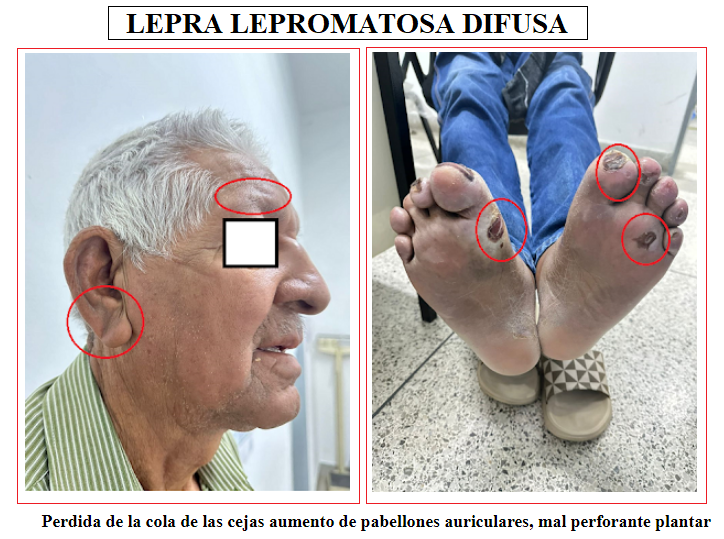
Se presenta principalmente en la lepra lepromatosa (LL) difusa
llamada también lepra de LUCIO y LATAPI, caracterizada
principalmente por la
ausencia de NÓDULOS en la piel. Se trata de una reacción leprosa grave y poco frecuente en estos
pacientes de
LEPRA LEPROMATOSA (LL) DIFUSA, no tratada o con tratamiento incompleto.
Este tipo de lepra es bastante común en
Centro América y México.
Las LESIONES CARACTERÍSTICAS
SON ÚLCERAS
las cuales inicialmente se presentan como
máculas purpúricas, que evolucionan posteriormente a lesiones ulcerosas
superficiales, de formas poligonales o anguladas, posteriormente
quedan lesiones cicatriciales atróficas, en forma de estrella.
Las lesiones se presentan principalmente miembros inferiores, pero otras partes del cuerpo pueden estar involucradas, como cuero cabelludo, cara y miembros superiores, pero no tan frecuentemente.
Hay sensación de quemazón, pero NO HAY, fiebre, tampoco síntomas
sistémicos marcados.
Como dijimos, se presenta en pacientes con
ALTA CARGA BACILAR, (lepra lepromatosa difusa), y puede ser potencialmente
mortal, si no se instaura un tratamiento oportuno.
BIOPSIA:
Histopatológicamente hoy día es considerado como una
PANVASCULITIS NECROTIZANTE, caracterizada por necrosis de la epidermis y vasos
sanguíneos en la dermis, ocasionada por una oclusión de los mismos,
la cual provoca inflamación vascular mediada por
inmunocomplejos.
INMUNOLOGÍA:
EL FENÓMENO DE LUCIO esta clasificado dentro de las reacciones
leprosas como
UNA REACCIÓN TIPO 2: la cual es una reacción inmunológica la cual esta
mediada por complejos inmunes, los cuales provocan inflamación severa de los vasos
sanguíneos, desencadenando trombosis y necrosis, que se manifiesta
con las lesiones antes mencionadas.
Esta REACCIÓN TIPO 2, también se presenta en el
ERITEMA NODOSO LEPROSO,
pero con variante clínica e histopatológica diferente.
El FENÓMENO DE LUCIO ES muy común en los pacientes con lepra difusa
en México, recientemente se le ha descrito asociado al nuevo agente
causal de la LEPRA descrito en 2.008 el
MYCOBATERIUM LEPROMATOSUS, en algunos casos se ha encontrado asociación con el Síndrome de
anticuerpos ANTIFOSFOLIPIDOS (anticardiolipinas), y es considerado la reacción mas anérgica del espectro de la
lepra lepromatosa (LL) difusa.
TRATAMIENTO:
1.- Terapia Multi-droga (MTD):
Tratamienco clásico de la LEPRA: Diaminodifenil sulfona (DDS),
RIFAMPICINA
y CLOFAZIMINE (Lampren)
2.-
Talidomida: Es un agente inmunomodulador el cual se usa en combinación
con corticosteroides orales, para controlar la
VASCULITIS NECROTIZANTE.
3.- Esteroides:
Prednisolona
o
prednisona
a altas dosis, para combatir la inflamación.
4.- Antibioticoterapia: Con buenos resultados, para tratar infección secundaria o
prevenirla, con buenos resultados.
5.-
Anticoagulantes y vasodilatadores:
para evitar la formación de coágulos y mejorar la
circulación.
6.- Hospitalización: Para monitoreo constante del paciente, ya que en algunos
casos el desenlace puede ser fatal
7.- Medidas de soporte:
tratamiento local de las ulceras y el dolor.
CONCLUSIONES:
El FENÓMENO DE LUCIO, es una manifestación cutánea, que se presenta
por lo general en pacientes con LEPRA LEPROMATOSA DIFUSA a nivel de
miembros inferiores, caracterizada por ULCERAS.
Inmunológicamente es una REACCIÓN LEPROSA TIPO 2, provocada por
complejos inmunes, muy común en
MEJICO, CENTRO (Costa Rica) y SUR-AMERICA, también se ha descrito en
países no endémicos para esta patología como
CANADA; puede haber desenlace fatal si no es tratada a
tiempo.
El FENÓMENO DE LUCIO es considerado la reacción más anérgica de todo el espectro inmunológico de la
lepra.
Como dato HISTÓRICO el mismo RAFAEL LUCIO NÁJERA, se inoculo a si mismo con este tipo de lepra de la que murió en
1886, a los 66 años.
Hoy, en nuestros días, EL FENÓMENO DE LUCIO es una realidad
en el mundo de la LEPRA.
En las 65 referencias los hechos, en la foto: CLÁSICO FENÓMENO DE
LUCIO, y biopsia de lesiones.
Saludo a todos.
Dr. José Lapenta.
Dr. José M. Lapenta.
EDITORIAL ENGLISH
===================
===================
Hello friends of the network. DERMAGIC is back with you again, today's
topic: LUCIO'S PHENOMENON, also known as
NECROTIZING ERYTHEMA.
HISTORY:
It is one of the types of leprous reactions (Type II reaction), rare and first described by RAFAEL LUCIO NÁJERA, a Mexican doctor, and IGNACIO ALVARADO, also Mexican, in 1852 as a necrotizing cutaneous reaction associated with diffuse non-nodular anergic leprosy, or in patients with incomplete treatment.
In 1936, JOSE FERNANDO LATAPI ZAMORA, also a Mexican dermatologist, described this manifestation of diffuse leprosy. Years later, FERNANDO LATAPI and AGUSTIN ZAMORA documented it microscopically in 1948, definitively naming it LUCIO'S PHENOMENON, or LEPROSY OF LUCIO-LATAPI.
CLINICAL CHARACTERISTICS:
It occurs primarily in diffuse Lepromatous Leprosy (LL), also known as LUCIO and LATAPI leprosy, characterized primarily by the absence of skin nodules. It is a severe and rare leprous reaction in patients with untreated or incompletely treated DIFFUSE LEPROMATOUS LEPROSY (LL).
This type of leprosy is quite common in CENTRAL AMERICA and MEXICO. The CHARACTERISTIC LESIONS ARE ULCERS, which initially present as purpuric macules, which later evolve into superficial ulcerative lesions with polygonal or angular shapes, and subsequently become atrophic, star-shaped scarring lesions.
The lesions primarily occur on the LOWER LIMBS, but other parts of the body may be involved, such as the scalp, face, and upper limbs, but not as frequently.
There is a burning sensation, but NO fever, nor any marked systemic symptoms.
As mentioned, it occurs in patients with a HIGH bacillary load (diffuse lepromatous leprosy) and can be life-threatening if not treated promptly.
BIOPSY:
Histopathologically, it is currently considered NECROTIZING PANVASCULITIS, characterized by necrosis of the epidermis and blood vessels in the dermis, caused by their occlusion, which causes immune-complex-mediated vascular inflammation.
IMMUNOLOGY:
LUCIO'S PHENOMENON is classified within leprosy reactions as a TYPE 2 REACTION: an immunological reaction mediated by immune complexes, which causes severe inflammation of the blood vessels, triggering thrombosis and necrosis, manifesting with the aforementioned lesions.
This TYPE 2 REACTION also occurs in ERYTHEMA NODOSUM LEPROSUM, but with a different clinical and histopathological variant.
LUCIO'S PHENOMENON IS very common in patients with diffuse leprosy in Mexico. It has recently been described in association with the new causative agent of leprosy, MYCOBATERIUM LEPROMATOSUS, described in 2008. In some cases, an association with ANTIPHOSPHOLIPID ANTIBODY SYNDROME (anticardiolipins) has been found. It is considered the most anergic reaction in the spectrum of diffuse lepromatous leprosy (LL).
HISTORY:
It is one of the types of leprous reactions (Type II reaction), rare and first described by RAFAEL LUCIO NÁJERA, a Mexican doctor, and IGNACIO ALVARADO, also Mexican, in 1852 as a necrotizing cutaneous reaction associated with diffuse non-nodular anergic leprosy, or in patients with incomplete treatment.
In 1936, JOSE FERNANDO LATAPI ZAMORA, also a Mexican dermatologist, described this manifestation of diffuse leprosy. Years later, FERNANDO LATAPI and AGUSTIN ZAMORA documented it microscopically in 1948, definitively naming it LUCIO'S PHENOMENON, or LEPROSY OF LUCIO-LATAPI.
CLINICAL CHARACTERISTICS:
It occurs primarily in diffuse Lepromatous Leprosy (LL), also known as LUCIO and LATAPI leprosy, characterized primarily by the absence of skin nodules. It is a severe and rare leprous reaction in patients with untreated or incompletely treated DIFFUSE LEPROMATOUS LEPROSY (LL).
This type of leprosy is quite common in CENTRAL AMERICA and MEXICO. The CHARACTERISTIC LESIONS ARE ULCERS, which initially present as purpuric macules, which later evolve into superficial ulcerative lesions with polygonal or angular shapes, and subsequently become atrophic, star-shaped scarring lesions.
The lesions primarily occur on the LOWER LIMBS, but other parts of the body may be involved, such as the scalp, face, and upper limbs, but not as frequently.
There is a burning sensation, but NO fever, nor any marked systemic symptoms.
As mentioned, it occurs in patients with a HIGH bacillary load (diffuse lepromatous leprosy) and can be life-threatening if not treated promptly.
BIOPSY:
Histopathologically, it is currently considered NECROTIZING PANVASCULITIS, characterized by necrosis of the epidermis and blood vessels in the dermis, caused by their occlusion, which causes immune-complex-mediated vascular inflammation.
IMMUNOLOGY:
LUCIO'S PHENOMENON is classified within leprosy reactions as a TYPE 2 REACTION: an immunological reaction mediated by immune complexes, which causes severe inflammation of the blood vessels, triggering thrombosis and necrosis, manifesting with the aforementioned lesions.
This TYPE 2 REACTION also occurs in ERYTHEMA NODOSUM LEPROSUM, but with a different clinical and histopathological variant.
LUCIO'S PHENOMENON IS very common in patients with diffuse leprosy in Mexico. It has recently been described in association with the new causative agent of leprosy, MYCOBATERIUM LEPROMATOSUS, described in 2008. In some cases, an association with ANTIPHOSPHOLIPID ANTIBODY SYNDROME (anticardiolipins) has been found. It is considered the most anergic reaction in the spectrum of diffuse lepromatous leprosy (LL).
TREATMENT:
1.- Multi-drug therapy (MTD): Classic treatment for leprosy: Diaminodiphenyl sulfone (DDS), rifampicin, and clofazimine (Lampren).
2.- Thalidomide: This is an immunomodulatory agent used in combination with oral corticosteroids to control necrotizing vasculitis.
3.- Steroids: Prednisolone or prednisone at high doses to combat inflammation.
4.- Antibiotic therapy: This therapy has been successful in treating or preventing secondary infection.
5.- Anticoagulants and vasodilators: To prevent clot formation and improve circulation.
6.- Hospitalization: For constant patient monitoring, as in some cases the outcome can be fatal.
7.- Supportive measures: Local treatment of ulcers and pain.
CONCLUSIONS:
Lucio's phenomenon is a cutaneous manifestation that usually occurs in patients with diffuse lepromatous leprosy of the lower limbs, characterized by ulcers.
Immunologically, it is a type 2 leprous reaction, caused by immune complexes, very common in Mexico, Central America (Costa Rica), and South America. It has also been described in countries not endemic for this disease, such as Canada. It can be fatal if not treated promptly.
Lucio's phenomenon is considered the most anergic reaction in the entire immunologic spectrum of leprosy.
As a HISTORICAL fact, RAFAEL LUCIO NÁJERA inoculated himself with this type of leprosy, from which he died in 1886, at the age of 66.
Today, the LUCIO PHENOMENON is a reality in the world of leprosy.
The facts are described in the 65 references, in the photo: CLASSIC LUCIO PHENOMENON, and biopsy of lesions.
1.- Multi-drug therapy (MTD): Classic treatment for leprosy: Diaminodiphenyl sulfone (DDS), rifampicin, and clofazimine (Lampren).
2.- Thalidomide: This is an immunomodulatory agent used in combination with oral corticosteroids to control necrotizing vasculitis.
3.- Steroids: Prednisolone or prednisone at high doses to combat inflammation.
4.- Antibiotic therapy: This therapy has been successful in treating or preventing secondary infection.
5.- Anticoagulants and vasodilators: To prevent clot formation and improve circulation.
6.- Hospitalization: For constant patient monitoring, as in some cases the outcome can be fatal.
7.- Supportive measures: Local treatment of ulcers and pain.
CONCLUSIONS:
Lucio's phenomenon is a cutaneous manifestation that usually occurs in patients with diffuse lepromatous leprosy of the lower limbs, characterized by ulcers.
Immunologically, it is a type 2 leprous reaction, caused by immune complexes, very common in Mexico, Central America (Costa Rica), and South America. It has also been described in countries not endemic for this disease, such as Canada. It can be fatal if not treated promptly.
Lucio's phenomenon is considered the most anergic reaction in the entire immunologic spectrum of leprosy.
As a HISTORICAL fact, RAFAEL LUCIO NÁJERA inoculated himself with this type of leprosy, from which he died in 1886, at the age of 66.
Today, the LUCIO PHENOMENON is a reality in the world of leprosy.
The facts are described in the 65 references, in the photo: CLASSIC LUCIO PHENOMENON, and biopsy of lesions.
In these 65 references the facts...
ULCERS IN LOWER LIMBS IN PATIENT WITH LEPROSY

Greetings to all.
Dr. José Lapenta.
Dr. José M. Lapenta.
===================================================================
REFERENCIAS BIBLIOGRÁFICAS / BIBLIOGRAPHICAL REFERENCES
===================================================================
REFERENCIAS BIBLIOGRÁFICAS / BIBLIOGRAPHICAL REFERENCES
===================================================================
H.- Lucio's phenomenon in a non-endemic region: A case report
(2024).
===================================================================
===================================================================
1.) Lepra type reactions
2.) Diffuse Painless Ulcerations
3.) [Lucio-Latapi leprosy and the Lucio phenomenon]
4.) [Lucio's leprosy].
5.) [22 years of leprosy: histopathology]
6.) Lucio's phenomenon.
7.) Lucio's phenomenon and diffuse nonnodular lepromatous leprosy.
8.) Lucio's phenomenon: a comparative histological study.
9.) [Diffuse lepromatous leprosy disclosed by cutaneous vasculitis. The Lucio phenomenon].
10.) Immunologic aspects of leprosy as related to leucocytic isoantibodies
and platelet aggregating factors.
11.) The role of protein malnutrition in the pathogenesis of ulcerative "Lazarine" leprosy.
12.) Dermal ultrastructure in leprosy.
13.) Lepromatous and tuberculoid leprosy: clinical presentation and cytokine responses.
14.) Leprosy (Hansen's disease) in South Dakota.
15.) [Virchowian Hansen's disease, Lucio's phenomenon, cryptococcosis].
16.) Erythema nodosum leprosum in Singapore.
17.) Epidermal keratinocyte Ia expression, Langerhans cell hyperplasia and lymphocytic infiltration in skin lesions of leprosy.
18.) Specific antigen and antibody to Mycobacterium leprae in the cryoprecipitate of a patient with Lucio phenomenon.
19.) In situ characterization of T lymphocyte subsets in the reactional states of leprosy.
20.) Ultrastructure of the dermal microvasculature in leprosy.
21.) Lucio's phenomenon: a comparative histological study.
22.) Serum macrophage migration inhibition activity in patients with leprosy.
23.) [Leprosy tests: diagnostic problems].
24.) Serum and tissue lysozyme in leprosy.
25.)[Reactional status of leprosy].
26.) Auricular chondritis as a rheumatologic manifestation of Lucio's phenomenon: clinical improvement after plasmapheresis.
27.) Contemplative immune mechanism of Lucio phenomenon and its global status.
28.) Plasma exchange therapy in Lucio's phenomenon.
29.) [Lepromatous leprosy with extensive ulcerations and cachexia. The Lucio phenomenon? Lazarine leprosy]?
30.) [2 cases of Lucio phenomenon in Paraguay].
31.) An unusual case of leprosy with pathological features common to Lucio's phenomenon.
32.) Primary diffuse lepromatous leprosy with erythema necrotisans (lucio phenomenon).
33.) The "Lucio phenomenon" in diffuse leprosy.
34.) [Macular leprosy of Lucio--antimalarials in leprotic reaction].
35.) [Dermatology in the Central American tropics. I. Lucio's spotted leprosy. Antimalarials in the leprous reaction].
36.) [Lucio's leprosy].
37.) [Lucio phenomenon in leprosy reactions].
38.) Lucio's phenomenon: an overview.
39.) Lucio's phenomenon: an immune complex deposition syndrome in lepromatous leprosy.
40.) [Lucio's leprosy].
41.) Antiphospholipid antibodies thrombotic syndrome misdiagnosed as Lucio's phenomenon.
2.) Diffuse Painless Ulcerations
3.) [Lucio-Latapi leprosy and the Lucio phenomenon]
4.) [Lucio's leprosy].
5.) [22 years of leprosy: histopathology]
6.) Lucio's phenomenon.
7.) Lucio's phenomenon and diffuse nonnodular lepromatous leprosy.
8.) Lucio's phenomenon: a comparative histological study.
9.) [Diffuse lepromatous leprosy disclosed by cutaneous vasculitis. The Lucio phenomenon].
10.) Immunologic aspects of leprosy as related to leucocytic isoantibodies
and platelet aggregating factors.
11.) The role of protein malnutrition in the pathogenesis of ulcerative "Lazarine" leprosy.
12.) Dermal ultrastructure in leprosy.
13.) Lepromatous and tuberculoid leprosy: clinical presentation and cytokine responses.
14.) Leprosy (Hansen's disease) in South Dakota.
15.) [Virchowian Hansen's disease, Lucio's phenomenon, cryptococcosis].
16.) Erythema nodosum leprosum in Singapore.
17.) Epidermal keratinocyte Ia expression, Langerhans cell hyperplasia and lymphocytic infiltration in skin lesions of leprosy.
18.) Specific antigen and antibody to Mycobacterium leprae in the cryoprecipitate of a patient with Lucio phenomenon.
19.) In situ characterization of T lymphocyte subsets in the reactional states of leprosy.
20.) Ultrastructure of the dermal microvasculature in leprosy.
21.) Lucio's phenomenon: a comparative histological study.
22.) Serum macrophage migration inhibition activity in patients with leprosy.
23.) [Leprosy tests: diagnostic problems].
24.) Serum and tissue lysozyme in leprosy.
25.)[Reactional status of leprosy].
26.) Auricular chondritis as a rheumatologic manifestation of Lucio's phenomenon: clinical improvement after plasmapheresis.
27.) Contemplative immune mechanism of Lucio phenomenon and its global status.
28.) Plasma exchange therapy in Lucio's phenomenon.
29.) [Lepromatous leprosy with extensive ulcerations and cachexia. The Lucio phenomenon? Lazarine leprosy]?
30.) [2 cases of Lucio phenomenon in Paraguay].
31.) An unusual case of leprosy with pathological features common to Lucio's phenomenon.
32.) Primary diffuse lepromatous leprosy with erythema necrotisans (lucio phenomenon).
33.) The "Lucio phenomenon" in diffuse leprosy.
34.) [Macular leprosy of Lucio--antimalarials in leprotic reaction].
35.) [Dermatology in the Central American tropics. I. Lucio's spotted leprosy. Antimalarials in the leprous reaction].
36.) [Lucio's leprosy].
37.) [Lucio phenomenon in leprosy reactions].
38.) Lucio's phenomenon: an overview.
39.) Lucio's phenomenon: an immune complex deposition syndrome in lepromatous leprosy.
40.) [Lucio's leprosy].
41.) Antiphospholipid antibodies thrombotic syndrome misdiagnosed as Lucio's phenomenon.
42.) "Lucio's Phenomenon" Associated with Mycobacterium
lepromatosis.
43.) Lucio's phenomenon, an uncommon occurrence among leprosy patients in Sri Lanka.
44.) Insight into the evolution and origin of leprosy bacilli from the genome sequence of Mycobacterium lepromatosis.
45.) Lucio Leprosy with Lucio's phenomenon, digital gangrene and anticardiolipin antibodies.
46.) Lucio's leprosy: a clinical and therapeutic challenge.
47.) Lucio's phenomenon: report of five cases.
48.) Severe leprosy reactions due to Mycobacterium lepromatosis.
49.) [Lucio's phenomenon in a patient with leprosy on Aruba].
50.) Lucio's phenomenon is a necrotizing panvasculitis: mostly a medium-sized granulomatous
arteritis.
51.) Livedo reticularis in type 2 lepra reaction: A rare presentation.
52.) Is it Lucio Phenomenon or Necrotic Erythema Nodosum Leprosum?
53.) Concomitant lucio phenomenon and erythema nodosum in a leprosy patient: clues for their distinct pathogeneses.
54.) Lucio's phenomenon. Case study of an exceptional response to treatment exclusively with
multibacillary multidrug therapy.
55.) [Lucio-Latapí leprosy and the Lucio phenomenon].
56.) Unusual Presentation of Necrotic Erythema Nodosum Leprosum on Scalp: A Case Report.
57.) Lucio's phenomenon: another case reported in Brazil.
43.) Lucio's phenomenon, an uncommon occurrence among leprosy patients in Sri Lanka.
44.) Insight into the evolution and origin of leprosy bacilli from the genome sequence of Mycobacterium lepromatosis.
45.) Lucio Leprosy with Lucio's phenomenon, digital gangrene and anticardiolipin antibodies.
46.) Lucio's leprosy: a clinical and therapeutic challenge.
47.) Lucio's phenomenon: report of five cases.
48.) Severe leprosy reactions due to Mycobacterium lepromatosis.
49.) [Lucio's phenomenon in a patient with leprosy on Aruba].
50.) Lucio's phenomenon is a necrotizing panvasculitis: mostly a medium-sized granulomatous
arteritis.
51.) Livedo reticularis in type 2 lepra reaction: A rare presentation.
52.) Is it Lucio Phenomenon or Necrotic Erythema Nodosum Leprosum?
53.) Concomitant lucio phenomenon and erythema nodosum in a leprosy patient: clues for their distinct pathogeneses.
54.) Lucio's phenomenon. Case study of an exceptional response to treatment exclusively with
multibacillary multidrug therapy.
55.) [Lucio-Latapí leprosy and the Lucio phenomenon].
56.) Unusual Presentation of Necrotic Erythema Nodosum Leprosum on Scalp: A Case Report.
57.) Lucio's phenomenon: another case reported in Brazil.
=============================================================